If you've ever plugged your height and weight into a BMI calculator and stared at the number wondering what it actually means, you're not alone. BMI is probably the most-quoted health number in the world — and also one of the most misunderstood.
Here's a plain-language look at where it's useful, and where it falls short.
What BMI Actually Measures
Body Mass Index is a simple ratio: your weight divided by the square of your height. That's it. It was developed in the 1830s by a Belgian mathematician, Adolphe Quetelet, who was trying to describe the "average man" for population statistics — not to assess any one person's health.
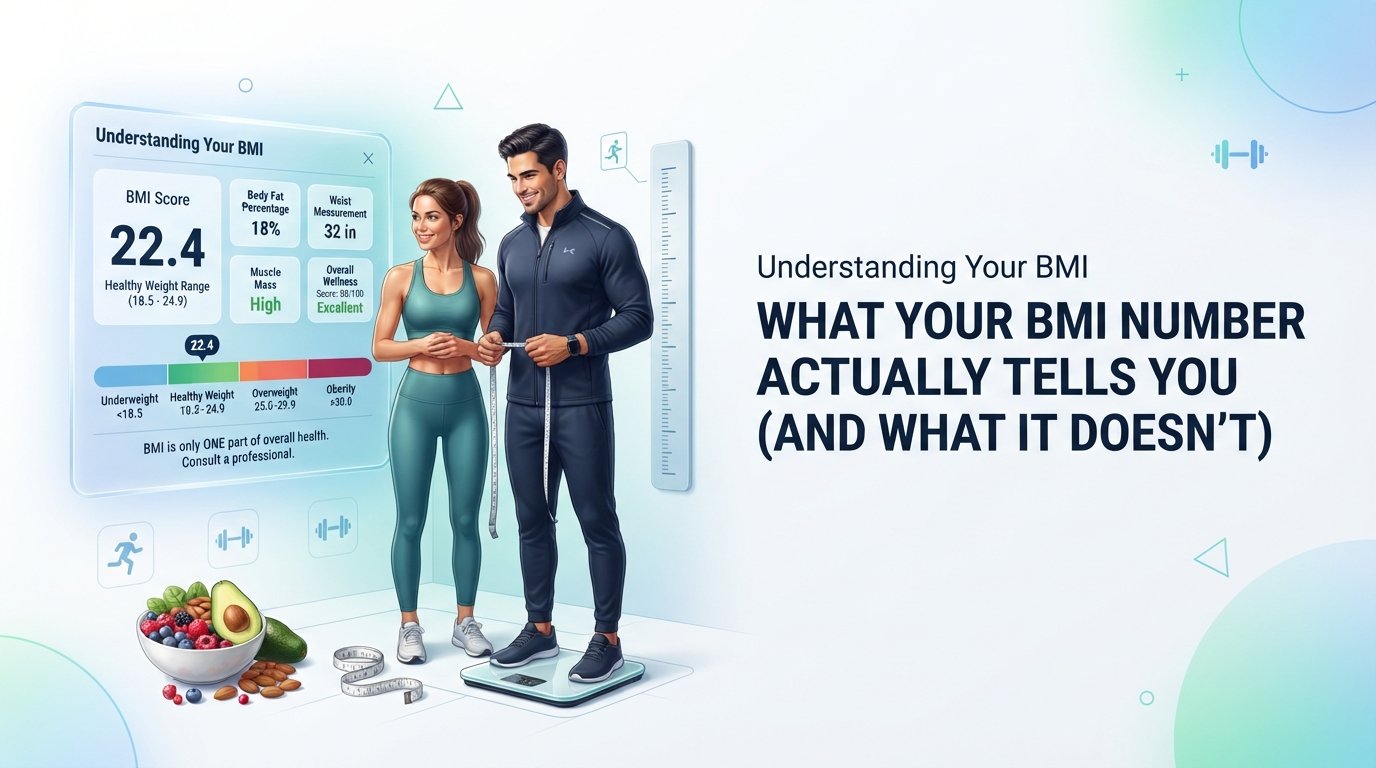
The formula gives you a single number, which then gets sorted into a category:
- Under 18.5 — Underweight
- 18.5–24.9 — Normal weight
- 25–29.9 — Overweight
- 30 and above — Obese
These categories, defined by the World Health Organization and used by health bodies like the CDC, are what turn a math ratio into something that sounds like a medical verdict.
Where BMI Is Genuinely Useful
At a population level, BMI is a solid tool. When researchers study thousands or millions of people, BMI correlates reasonably well with health risks like type 2 diabetes, heart disease, and certain cancers. It's cheap, fast, and doesn't require any special equipment — just a scale and a tape measure.
For most adults with an average body composition, it's also a reasonable first-pass indicator. If your BMI is 32, it's a fair bet you're carrying more body fat than is ideal for your health, even without further testing.
Where BMI Falls Short
The core problem: BMI can't tell the difference between muscle and fat.
A few examples where this matters:
- Athletes and bodybuilders often land in the "overweight" or even "obese" category despite having very low body fat, simply because muscle is denser than fat.
- Older adults may have a "normal" BMI while having lost significant muscle mass and gained fat — a pattern sometimes called "normal weight obesity."
- Body shape and fat distribution aren't captured at all. Two people with the same BMI can have very different amounts of visceral fat (the kind around your organs, which carries more health risk) versus fat elsewhere.
- Ethnicity affects the relationship between BMI and health risk. Research has shown that some populations, including many South and East Asian groups, face higher health risks at lower BMI thresholds than the standard categories suggest.
What to Use Alongside BMI
If you want a fuller picture, BMI works best paired with a measurement that actually estimates body composition:
- A Body Fat Percentage Calculator using the Navy circumference method gives you an estimate of how much of your weight is actually fat, using just a tape measure.
- An Ideal Weight Calculator shows a healthy weight range using several clinical reference formulas, not just BMI.
- If your goal involves changing your weight, knowing your daily calorie needs matters more day-to-day than any single static number.
The Bottom Line
BMI is a useful, free, five-second screening tool — not a diagnosis. It's a reasonable starting point for most people, but if you're very muscular, older, or simply want a clearer picture of your body composition, it's worth looking at body fat percentage alongside it. The real goal isn't to chase a number; it's to understand what's actually going on with your body.
This article is for general informational purposes and isn't a substitute for advice from a qualified healthcare provider. Sourced from public health guidance published by the World Health Organization and the U.S. CDC.
Frequently Asked Questions
Is a high BMI always a health risk?
Not necessarily on its own. BMI is a screening tool, not a diagnosis — very muscular people can have a "high" BMI with low body fat, while someone with a "normal" BMI could still carry unhealthy levels of visceral fat.
What's a healthy BMI range?
For most adults, 18.5–24.9 is classified as the normal weight range by the WHO and CDC. Ranges can differ slightly for certain populations, so it's worth discussing your own result with a doctor.
Should I use BMI or body fat percentage?
BMI is faster and needs no extra measurements, while body fat percentage (like the Navy method) gives a more direct read on body composition. Using both together gives the fullest picture.
Check your own BMI
Get your number and category in seconds.