Ever slept for 8 hours and still woken up groggy — then another night slept for only 6 and felt oddly fine? It's not random. The timing of when you wake up relative to your sleep cycle matters just as much as how long you sleep.
Want your exact bedtime and wake-up times? Use our sleep cycle calculator. For daytime sleep, see our guide to the perfect nap length.
Sleep Isn't One Long, Flat State
It's tempting to think of sleep as a single uniform block — you're either "asleep" or "awake." In reality, your brain moves through a repeating sequence of stages all night long, and each stage does something different:
- Light sleep — the transition into sleep, easy to wake from.
- Deep sleep — the most physically restorative stage, where growth hormone is released and the body repairs itself. Waking from this stage is what causes that heavy, disoriented grogginess known as sleep inertia.
- REM sleep — the dreaming stage, important for memory consolidation and emotional processing.
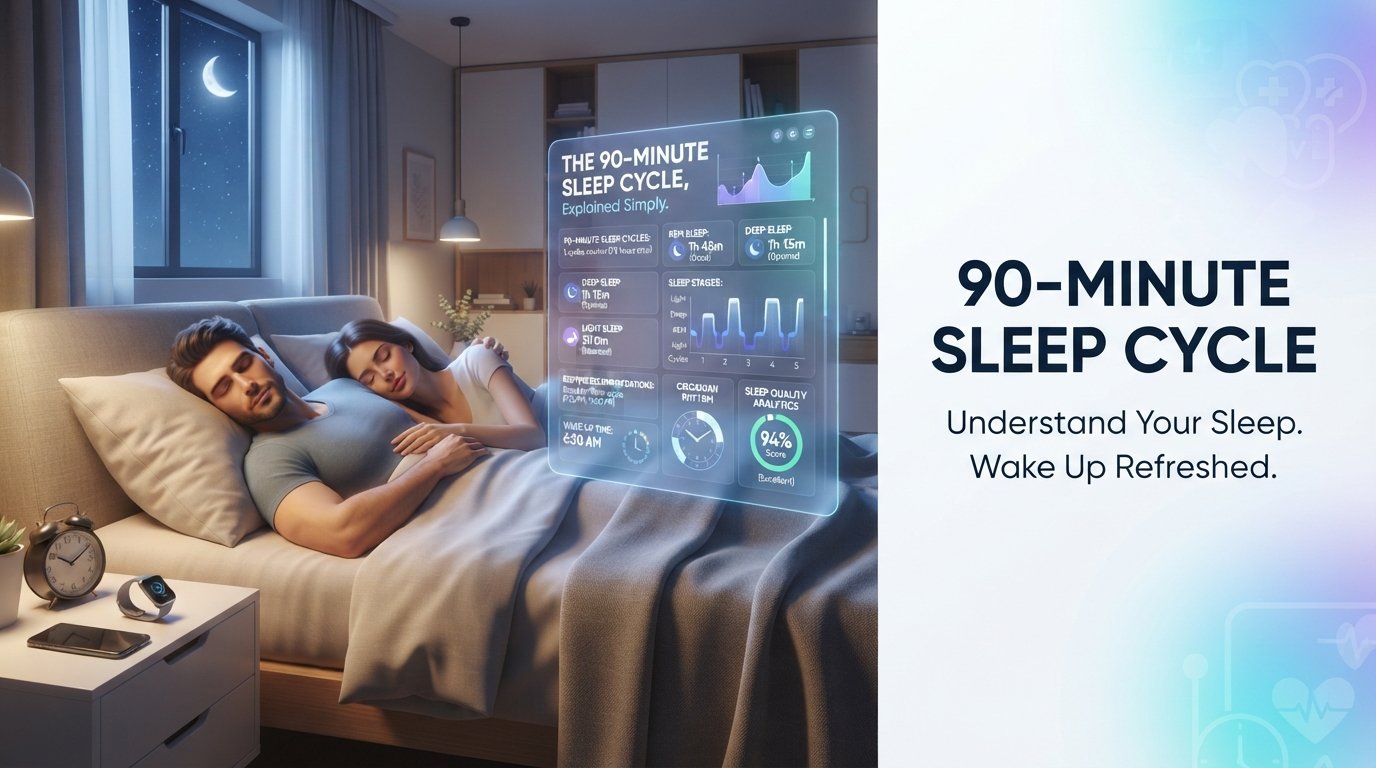
One full pass through these stages, as described by the National Heart, Lung, and Blood Institute (NHLBI), takes roughly 90 minutes, though it can range from about 80 to 120 minutes depending on the person and the night. This is what's called a sleep cycle, and a typical night includes 4 to 6 of them back to back.
Why Waking Up Mid-Cycle Feels So Bad
Here's the key insight: deep sleep is heaviest in the earlier cycles of the night, while REM sleep becomes longer and more frequent toward morning. If your alarm goes off in the middle of a deep sleep phase, you're being pulled out of the stage where your brain is least prepared to wake up — hence the grogginess, even after a technically "full" night's sleep.
On the other hand, waking up naturally between cycles — when you're in light sleep — tends to feel noticeably easier, even if the total sleep time is a bit shorter.
How to Use This
This is exactly the idea behind timing sleep in multiples of 90 minutes rather than round numbers of hours. Instead of aiming for "8 hours," the better target is often "5 full cycles" (7.5 hours) or "6 full cycles" (9 hours) — landing your wake-up time between cycles instead of in the middle of one.
Our Sleep Cycle Calculator does this math for you two ways:
- Have a wake-up time in mind? It works backward to show you several good bedtimes, each ending on a full cycle.
- Going to bed right now? It works forward to show you the best times to set your alarm.
Both include a small buffer for the time it typically takes to actually fall asleep (about 14 minutes on average), so the numbers reflect real bedtime, not just lights-out time.
How Many Cycles Do You Actually Need?
General sleep guidance from bodies like the CDC and National Institutes of Health recommends 7–9 hours per night for most adults — which lines up neatly with 5 to 6 full sleep cycles. Fewer than 4 cycles a night on a regular basis is generally associated with the effects of sleep deprivation, regardless of how well-timed the wake-up is.
In other words: cycle timing helps you feel better within a reasonable sleep duration — it's not a substitute for getting enough sleep in the first place.
Sleep Doesn't Happen in Isolation
Sleep quality is tied to the rest of your day. If you're training hard, staying in the right heart rate zones rather than constantly pushing to peak effort can help you avoid the kind of overtraining that disrupts sleep. And eating enough — checking your daily calorie needs — matters too, since being significantly under-fueled can fragment sleep just as much as bad timing does.
The Bottom Line
The number of hours you sleep matters, but so does where your alarm lands relative to your body's natural 90-minute rhythm. A little timing math can be the difference between waking up groggy and waking up actually rested — no extra sleep required, just smarter timing.
This article is for general informational purposes and isn't a substitute for advice from a qualified healthcare provider, especially if you're dealing with ongoing sleep problems. Sourced from public sleep science guidance published by the NHLBI and the CDC.
Frequently Asked Questions
Is 90 minutes exact for everyone?
No — cycle length typically ranges from about 80 to 120 minutes and varies by person and by night. 90 minutes is a widely used average for estimation.
Why do I feel more tired after 8 hours than after 6?
If the 8-hour sleep ends mid-cycle (in deep sleep) and the 6-hour sleep ends between cycles, the shorter sleep can genuinely feel more refreshing.
How long does it usually take to fall asleep?
This calculator assumes about 14 minutes, a commonly cited average, but personal sleep onset time can vary quite a bit night to night.
Time your bedtime right
Find your ideal bedtime or wake-up time.